


A client recently shared this chart with me, and it's been sitting with me ever since. It's not flashy, but it captures something I find myself explaining to clients often: even the strategies we believe in as core investing “truths” can go years, sometimes a decade or more, without paying off.
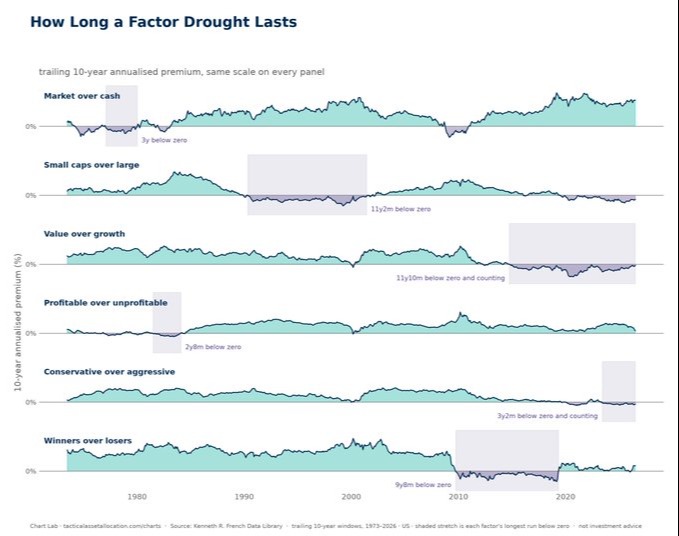
The chart tracks what the investment world calls “factor premiums.” I'll spare you the technical definition. It really means that there are certain characteristics of securities—small vs. large, cheap vs. expensive, etc.—that have historically outperformed over long stretches of time.
But the parts of the chart that caught my attention are the shaded gray sections. Those are the stretches where the “factor”—that's supposed to win over time—didn't win. And in some cases that wasn’t just a short-lived correction.
For example, one generally held investing principle is that value stocks are supposed to beat growth stocks over the long run. And from roughly 1970 to around 2015, they did. Then they stopped and have underperformed growth stocks since. That's not a bad month or a bad year. That's a decade of a strategy potentially working against you, even though the long-term evidence behind it is real. Note: During this time period, while the value factor did not work in the U.S., it was working outside the U.S.
Small companies are supposed to outperform large ones. That is another generally accepted investing belief. But it’s the same story—years of underperformance, shaded gray on the chart. If you were an investor who leaned hard into value or small caps over the last decade or so, it's been a rough stretch no matter how sound the underlying research was.
So, does that mean the theories are wrong? I don't think so—but I'll be honest with you: nobody knows for sure. Just because something worked for forty years doesn't guarantee it keeps working for the next forty. In addition, these factors are not correlated with each other. In other words, when one factor doesn’t work another very well could be working. For that reason, the goal is to have a multi-factor approach.
A friend of mine, Brian Portnoy, has a great line about this: diversification means always having to say you're sorry. If you're properly diversified, something in your portfolio is likely to be underperforming at any given moment—that's not a flaw, that's the design. If you invest in the whole market, like the S&P 500, you own both value and growth, both small and large companies. You're never going to be the person who “called it” on any one factor, but you're also never the person who bet everything on the wrong one.
That leads to a question I hear a lot: if growth has beaten value for over a decade, does that make growth investors smarter? I don't think so. I think it makes them lucky—they happened to be leaning in the direction the market was leaning. That's very different from skill, and it's not something I'd want to build a retirement plan around.
The same idea shows up with cash. Historically, markets go up more often than they go down — something like eight years out of every ten. But “usually” isn't “always.” From 2007 to 2009, the market spent roughly two and a half years underwater. If you needed your money during that window, it didn't feel like a “markets usually go up” kind of market.
So what's the actual takeaway? It's not that these strategies don't work, and it's not that you should try to guess when they'll turn back around — because nobody, including people who have spent entire careers studying this, can tell you when that will happen. It's that diversification and time in the market matter more than chasing whatever happens to be working right now. Owning a mix of these strategies, and staying invested through the droughts as well as the streaks, is the approach I keep coming back to with my own clients.
If you'd like to talk through what this looks like in your own portfolio, I'm happy to walk through it with you.